ABOUT US
We are a family of 4 living and working on a smallholding in West Wales. Our Permaculture Farm has been our home for 20 years, our youngest family member is 16.
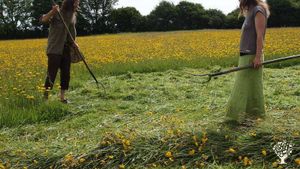
The smallholding is owned by a charity, with the aim of educating people about low impact living, Permaculture, biodiversity and environmental conservation. It is 24 acres in total, including 6 acres of wildflower meadow, permanent pasture, allotments, woods and gardens, all farmed by hand using traditional tools such as the scythe. We own and farm an additional 4 adjoining acres of pasture.
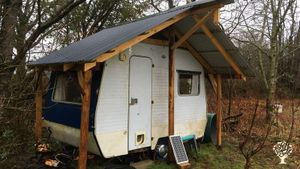
We live in a wooden caravan that we built ourselves, with help from the Trust. We are off grid - electricity comes from solar panels and a self-built Hugh Piggott 3f wind turbine, water comes from a spring on the land.
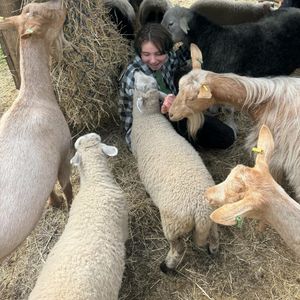
We aim at self-reliance. We grow a lot of the vegetables we eat, a good proportion of the fruit, all of the meat and some of the dairy products. We have a small flock of Shetland sheep for wool and meat, a micro herd of Shetland Cattle for milk and meat and about a dozen Warre beehives for honey. The majority of the produce from our livestock is for our own use.
We also run a Scythe business from the site - running courses and selling scythes direct to local people and through our website. WWOOFers will not be asked to carry out any tasks towards income generating parts of our lives. Some paid work in the scythe business may be available in the spring / summer. We're happy to teach WWOOFers to scythe if they come at a scything time of year!
SKILL SHARES
We like to share skills and hope that as well as helping us with the work that needs doing, WWOOFersare able to take away new skills and experiences from the time they spend with us. Both Phil and I benefited immensely from the skills we learnt whilst WWOOFing before settling at the Trust.
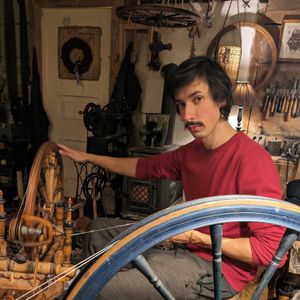
Skills we can share include - scything, gardening, permaculture, some aspects of Biodynamic gardening, hand haymaking, animal care, low impact living, off grid electricity production, knitting, using natural dyes, various methods of food preservation.
WWOOFing WITH US
In general, all tasks are carried out using hand tools. Tasks on the farm are seasonal. In winter it is more likely to be activities such as hedge laying, clearing and small building projects. There are tasks in the vegetable garden and edible perennial plantings all year, but it is especially busy in the spring / early summer. From June until late August / September we make hay by hand.
I have a daily routine of animal tasks and there is always the chance of an unexpected event such as a bee swarm to join in with!
We ask WWOOFers to help the equivalent of 4 days out of every 7 days that you are staying. We'll make mutually agreeable arrangements with you before you come. To get the most out of your stay with us we recommend staying 3 - 4 weeks. This gives you time to settle into the rhythms of farm life and gain a better understanding of how we work. Applications for longer stays are welcome.
Come prepared to be outdoors in all weathers! Sometimes you will be helping alongside us or other WWOOFers, sometimes you will be doing tasks alone. There’s always company at shared meals. There may be additional volunteering and social opportunities available during your stay, eg on our monthly volunteer workdays that are open to the local community or during events we run.
We provide meals on the days that you are volunteering. We ask people to self-cater on non-volunteering days. We provide basic provisions for self catered meals eg rice, pulses. There are two local shops for WWOOFers to get any additions they might want. There is a fully equipped kitchen in the barn that you will have access to. This is a beautiful corner of Wales and there is plenty to explore during your free time. We can lend maps and provide information on local sites of interest.
Phil and I tend to work all days equally, making no exceptions for weekends. Especially during the hay making season work can go on until late into the evening, but we will always try to ensure that there is adequate time to rest, explore the area etc.
We are open to other WWOOFing arrangements, especially overwinter if people are looking for somewhere to stay for a bit longer. Get in touch if you would like to do something different to the above.
Phil and I started our land based journey with WWOOF (we actually met whilst WWOOFing!) and have hosted WWOOFers for many years.
ACCOMODATION AND FOOD
Single people or couples usually stay in one of our small touring caravan. The caravans and most of the shared DPF spaces do not have electricity. We provide rechargeable lamps and spaces where devices can be charged.
Please note we do not have accommodation (other then camping) for larger groups / families. We have space for live in vehicles if that is how you are travelling, though be aware that our lane is narrow with low overhanging trees.
All WWOOFers have access to the Red Barn, which has a fully equipped kitchen and a Rayburn for heating. It also has compost toilets and a solar shower.
We have an off-grid electricity system in our house (solar and wind). Electricity can be limited during the winter. Mobile phones etc can be charged using a usb charger. We have a phone line and can provide wifi access, though it's rather slow. This is rural West Wales after all!
We have a spring for water. Water awareness is necessary year round, but especially during extended dry periods (though the spring has never run dry yet!). We have a washing machine but electricity production and water levels can limit the amount it can be used.
Generally, shared meals are eaten with us in our house or in the Roundhouse. We aim to eat mostly organic, locally produced, seasonal food. For us, our home grown produce is an integral part of our sustainable living practice and that includes produce from our animals (for example, using animal fats for cooking means we buy in very little oil). Whilst we can cater vegetarian (or vegan), we really appreciate it when WWOOFers are willing to embrace more or all of our food offering. We eat less meat in the summer, therefore we are happy to cater vegetarian / vegan March - Oct if required. Please let us know if you have any special dietary requirements eg vegan, gluten free before you arrive.
EXPLORING
We are situated on the edge of a beautiful valley that was once the heart of the Welsh Woolen industry. The National Woollen Museum is located in the nearby village of Drefach Felindre.
There is a good network of footpaths in the local area to explore and we are about 15 miles away from the stunning Cardigan Bay coast.
There is a bus link roughly every hour from Drefach Felindre (1.5 miles from the farm) to Cardigan or Carmarthen.
Read more
Learning opportunities
Vegetable farming
Fruit or nut farming
Sheep or goat farming
Dairy farming
Beekeeping
Meat processing
Vegetable or fruit preservation
Renewable energy production
Food justice / sovereignty
Methods or systems
Biodynamic agriculture
Holistic management
No-till farming
Permaculture
Regenerative agriculture
Host type
Nonprofit / Community
Former WWOOFer
9.7
Hectares
|
24
Acres